Rotary furnace pyrometallurgy is one of the core processes for processing medium-grade tin concentrate and producing crude tin. It is renowned for its strong raw material adaptability and continuous production capacity. The process primarily involves raw material preparation, reduction smelting, product separation, and flue gas treatment.
Raw material preparation is fundamental. Tin concentrate (containing 40%-70% tin) must be mixed with a reducing agent (anthracite/coke powder), flux (primarily limestone/lime), and return materials (such as soot and tin-containing slag) in precise proportions. Proper mixing is crucial for controlling reduction efficiency and forming a good slag.
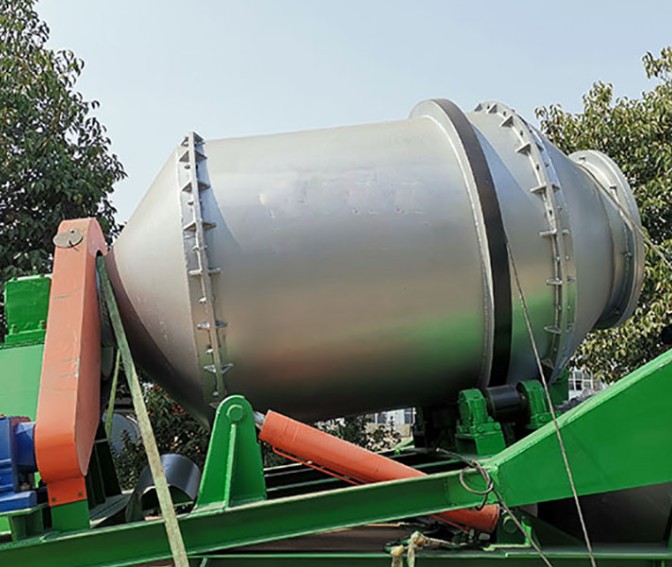
Reduction smelting takes place in the core area of the rotary furnace. The mixed charge is added at the rear of the furnace and moves toward the inclined furnace head (high-temperature zone) as the furnace rotates (1-4 rpm). After the furnace undergoes dry preheating and possible oxidative desulfurization/arsenic removal in the medium temperature zone, a key reaction occurs in the high temperature reduction zone of 1300-1450℃: carbon burns to provide heat and produces CO reducing agent, reducing SnO? to metallic tin. At the same time, part of the iron oxide is reduced, and the flux reacts with the gangue (such as SiO?) to form slag, forming a liquid slag mainly composed of calcium silicate.
Product separation is completed at the furnace head. The dense crude tin melt (>80% Sn, containing impurities such as Fe and As) is discharged from the lower layer and cast into ingots. The less dense liquid slag (target Sn content <1%) is discharged from the upper layer and can be further processed to recover residual tin. Care must be taken to control the reduction intensity to prevent the formation of difficult-to-treat tin-iron alloys (hard slag).
Flue gas treatment is essential. High-temperature flue gas (containing dust, SO?, and volatile tin) is discharged from the furnace tail. After waste heat recovery and cooling, it passes through cyclones, electrostatic filters, or baghouses to efficiently capture the tin, lead, and zinc-rich dust (for return or recycling). Finally, it undergoes desulfurization and arsenic removal before reaching emission standards.
The advantages of rotary furnace pyrometallurgy lie in its large processing capacity, wide raw material adaptability, and high thermal efficiency. It is particularly suitable for processing tin concentrates with high iron content or complex compositions. The crude tin produced can be subsequently refined (through smelting, impurity removal, crystallization and fractionation) to produce high-purity refined tin. This process is a mainstream technology in modern tin metallurgy, fully demonstrating the key role of the rotary furnace in the pyrometallurgical smelting of complex non-ferrous metals.