



NEWS&EVENTS
Home > News&Events > Company news > What are the primary materials used for the cathode and anode in a copper electrolytic cell?
In the fields of hydrometallurgy and copper refining, the selection of anode and cathode materials for electrolytic cells directly determines the efficiency, energy consumption, and product quality of the electrochemical process. Depending on the specific process objectives—whether electrolytic refining or electrowinning—anode and cathode material configurations can be broadly categorized into the following two typical systems:
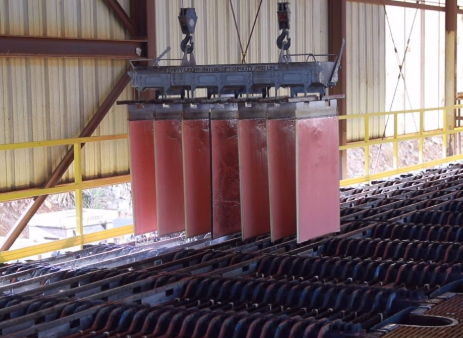
I. Electrolytic Refining System (Soluble Anodes)
This system is primarily utilized for the refining of crude copper to produce high-purity cathode copper. Its standard configuration consists of:
Anodes: Soluble anodes fabricated from crude copper. During the electrolysis process, the anode undergoes electrochemical dissolution; copper atoms lose electrons to become copper ions, which then enter the electrolyte solution, while precious metals such as gold and silver settle as "anode slime," facilitating their subsequent recovery. The dissolution rate of the anode must be strictly matched with the deposition rate at the cathode to maintain a stable cell voltage.
Cathodes: Typically consist of pure copper starter sheets. At the cathode, copper ions gain electrons and deposit as high-purity copper (with a purity often exceeding 99.99%). The surface flatness of the cathode material directly influences the compactness of the copper crystal structure and its peelability.
II. Electrowinning System (Insoluble Anodes)
This system is suitable for recovering copper from low-grade solutions—such as heap leach liquors or spent electrolytes—during waste treatment processes. Its configuration is as follows:
Anodes: Typically employ lead-silver alloys or titanium-based coated electrodes. These types of anodes do not dissolve during electrolysis; instead, they serve solely to catalyze the oxygen evolution reaction. The lower the oxygen overpotential, the lower the cell voltage and the greater the energy savings. Lead-silver alloy anodes require periodic scraping to remove the passivating layer of lead dioxide that forms on their surface; conversely, while titanium electrodes entail higher initial costs, they offer dimensional stability and are non-contaminating.
Cathodes: Commonly utilize copper starter sheets or titanium plates. During electrolysis, copper ions are reduced and deposited at the cathode, resulting in a gradual decrease in the copper concentration within the solution. Since the anode does not supply copper ions, copper salts (such as copper sulfate) must be periodically added to the electrolyte to maintain the copper ion concentration within the required process range (typically 30–50 g/L). The foregoing constitutes the fundamental rationale behind the selection of cathode and anode materials in copper electrolytic cells: the cathode is responsible for depositing high-purity copper, while the anode—depending on whether or not it participates in dissolution—regulates the supply of copper ions or facilitates the oxygen evolution reaction.